

Great seal[]
The infobanner on the right has a picture of the "Great Seal of the United Federation of Planets". However, has it ever been referred to as such? In particular, while it's a seal, where does the "great" come from. Sounds like fanon to me. -- Capricorn (talk) 12:51, October 15, 2012 (UTC)
- most real countries (and states) call the main seal that represents the country the "Great Seal of ..." see here: http://en.wikipedia.org/wiki/Special:PrefixIndex/Great_Seal_of, so it's not a fan based term it's more of a historic/tradition based term Chasemarc (talk) 14:27, January 11, 2013 (UTC)
The way you explain it, it absolutely is a fan based term. A likely name is still not a canon name. -- Capricorn (talk) 14:57, January 11, 2013 (UTC)
alternate reality Federation?[]
is there a page for the alternate reality (JJ Abrams universe) Federation or is MA treating it as the same as the Prime Universe Federation? Chasemarc (talk) 18:31, January 8, 2013 (UTC)
- I think that right now we don't need a separate article for it, as we know very little about the alt-UFP itself. They didn't say much beyond Pike's brief reference(near the top of the page) which is written as an alt-reality note. As we start to learn more about it, we can expand the brief mention into a section of this article, and perhaps beyond that its own page. 31dot (talk) 21:27, January 8, 2013 (UTC)
- Hey, just pointing out that pike said that STARFLEET was a "peacekeeping and humanitarian armada," not that the Federation was. – The preceding unsigned comment was added by 146.115.131.3
- Pike: "You understand what the Federation is, don't you? It's important. It's a peacekeeping and humanitarian armada." --Pseudohuman (talk) 07:05, February 22, 2013 (UTC)
economy[]
I don't want to edit war, but Instantventure keeps adding that new world economy replaced socialism and communism and the replicator had something to do with the reason why people were not concerned about accumulating wealth. Both of which are not from the cited episodes as far as i know and are personal fan interpretation and speculation. As far as I know, it was all about adapting the "philosophy of self-enhancement" as was stated in "In the Cards" etc. and the fate of communism/socialism have not been addressed at any point in the series. --Pseudohuman (talk) 03:47, October 1, 2013 (UTC)
- Moved here from my talk page.
- Why did you remove my revisions? Capitalism wasn't the only system of economies on earth at the time, in fact, socialism is the most common system. Communism is also a prominent system today. My revision was to create political neutrality and present facts.
- Concerning my other revisions, It is shown that Federation members could acquire materialistic things Miles O'Brien replicated an Alamo Model and Federation members are shown to be able to have luxuries like decorations, etc. throughout the series. Although there ideology is to generally not be materialistic, it is shown that Federation members are allowed to have and fulfill material desire. The elimination of poverty can also be attributed partly to advancing technology, like replicators. The philosophy of self enrichment is a general one. --Instantventure (talk) 22:27, October 1, 2013 (UTC)
- I did not remove the edits, but I agree with it. Such information about the motivations behind the Federation's economic policies is speculation. 31dot (talk) 22:32, October 1, 2013 (UTC)
- if the Federation eliminated currency in its system then clearly socialism and communism died with it. – The preceding unsigned comment was added by Instantventure (talk • contribs)
Federation citizens/organizations/government used Federation credits as currency. I don't think it has been stated what currency was used in the United Earth. People still got payed for their work. It just wasn't an important aspect of life for most people. With Carter Winston however for example his wealth became an important part of interstellar affairs. --Pseudohuman (talk) 22:18, October 3, 2013 (UTC)
- I think it's possible to have a compromise. I found it in the script for "Encounter at Farpoint". It is an immense courtroom meant to reflect strength and power. (We'll discover that it dates back to the mid-21st Century post-atomic crisis era.) Both decor and legal procedures reflect the time when a desperate Humanity, still wounded and bleeding from nuclear war, sought answers to its pain and problems through the merciless strength of a new form of dictatorial government representing neither capitalism nor communism. [1] So, for our purposes, we have as close a statement that people did reject both economic systems, and from the episodes, we know that within decades a new economic system arose.Throwback (talk) 23:28, October 3, 2013 (UTC)
- That wouldn't be a means to get the proposed in-universe edit in the article. 31dot (talk) 23:34, October 3, 2013 (UTC)
Agencies[]
- Can we add Merchant Service in "Executive Agencies section" ? Thank you C-IMZADI-4 (talk) 21:11, April 4, 2015 (UTC)
- I don't think it was ever identified like that. For all we know it might be a private company, or an agency associated with just one member planet, or who knows what else. So I would suggest no. -- Capricorn (talk) 04:31, April 6, 2015 (UTC)
ok, thak you C-IMZADI-4 (talk) 08:31, April 6, 2015 (UTC)
Weird Glitch[]
Um…where's all the content for this page? This may just be a glitch for macs or something but I can't see any content on this page. – The preceding unsigned comment was added by 159.191.186.254
- It happens all the time. The content is still there, it just doesn't show up. --LauraCC (talk) 17:12, October 6, 2015 (UTC)
Reputation[]
The section on the Federation's reputation seems to be just a collection of ruminations on how the Federation sucks, which people who think figuring out how the good guys are really the bad guys and vice versa in fiction makes them cool counterculture rebels just love. It includes an unhinged rant from a narcissist with delusions of grandeur trying to justify treason. This whole section probably ought to be stricken. – The preceding unsigned comment was added by ShorinBJ (talk • contribs)
- I agree that not all the people here are particularly respectable or trustworthy. I might make notes on that, but I think it is against Memory Alpha's policy to make judgements on the reliability of a particular character. Perhaps someone could add some notes on the 23rd century Klingon perspectives about how the propaganda in the Klingon Empire made-up or exaggerated negative things about the Federation. Most of these statements right now are from political enemies of the Federation, so they want to make it look bad. (Ruf'ao I do not count as being an ally of the Federation). Another thing that could be done that I see is lacking from the article is point out examples of all the people who wanted to join the Federation, such as the Kes (government) on the planet Kesprytt III (TNG: "Attached"), Angosia III in TNG: "The Hunted", and Bajor during part of DS9. We could also note that the Bajoran Provisional Government chose to be associated with the Federation rather than run DS9 independently or become allied with someone else, such as the Romulan Empire, Klingon Empire, or Ferengi, probably because the Federation had a reputation of being fair, powerful, and open, rather than the Romulans who were rather isolationist, the Ferengi who were exploitative, or the Klingons who seemed to have an unstable political situation at the time. It seems to me that the positive reputation of the United Federation of Planets has been ignored in this article in favor of the negative views. --ВорЧа (talk) 08:28, May 12, 2017 (UTC)
- About the recently deleted parts on "reputation," I can see why some were deleted, such as Shinzon's quote which was more or less just a reference to the Federation (I suppose the fact he heard about it could count as reputation though), and Gul Dukat's statment that was deleted was a political, "diplomatic" message rather than a real statment of what was thought about the Federation. However, why did Quark's analogy to the Federation as root beer get deleted? It to me seems like a legitimate view of the Federation, with less political motivation than the others. And why should we not also delete Ru'afo's view, and that of the Changeling impersonator? They do not seem to me to be any more legitimate than the claims of the Michael Eddington which were deleted. I think that Eddington's statements and especially those of Quark should be put back or a fair bit more should be removed.--ВорЧа (talk) 07:23, May 26, 2017 (UTC)
verb tense[]
Shouldn't the opening section be in present tense? (24.205.83.199 07:16, August 25, 2017 (UTC))
- On Memory Alpha, virtually all pages are in the past tense, to keep a consistent viewpoint across Star Trek eras. See MA:POV. 31dot (talk) 09:24, August 25, 2017 (UTC)
Politics/political culture of the UFP (communism?)[]
Hello. I'm a longtime fan of Star Trek and, having studied some eastern philosophies as well as Communist and capitalist theory, have a few observations that may be poignant to add to the article in some form.
I'll keep it as short as I can: the Federation, especially as presented in TNG, quite clearly displays to me a society that most would indeed consider to be a "communist utopia". This, however, is not obviously and directly stated, but may be inferred from the obsolescence of nationalistic thought (but not cultural innovation and variety - see Picard's pride in his French heritage contrasting with his ridicule of Q's dressing as a mid-20th century nationalist American military commander) and obvious reliance on a worldview lacking nationalism of any kind beyond the natural value of life, experience, and the individual in and of themselves.
By valuing life's experience in and of itself - in a society in which "people exist to better themselves and others around them", or whatever precisely it is they say - they have thrown off the implicated shackles of aggressive nationalism or economic motive as the dictator of their intent, but rather exist in a simpler state devoted to their duty to each other as living beings and the act of living that life to the full without constraints of a domineering capitalist system of neoliberal economic thought and subservience to an aggressive interpretation of nationalistic thought.
This focus on life's experience as an end in itself, both for the individual and the group, is also mirrored in Taoist and Confucian philosophy, which appears to be well expressed through this philanthopic and compassionate (yet organised) mindset. In Confucianism, a major element of ethics is the acceptance of your place in the society as a whole owing to the privelege of contribution to society and natural order of Human hierarchies, which may explain the willingness of individuals to exist within a stratified framework of military command. Taoism, on the other hand, offers a philosophy which propounds a kind of basic innocent Human joy in even life's most basic processes and focuses on removing all the 'schismatic' or 'schizophrenic' thought that civilisation brings, including a rejection (amongst other things) of aggressive nationalism and aggressive devotion to entirely theoretical causes of religious doctrine or economic imperative.
All of these elements together seem to create the conditions for a beneficent space-faring society organised towards the liberty of the individual as a part of a peacekeeping armada exploring the stars for no other necessary reason than simply to "go where no one has gone before" in a spirit of intrepid discovery. And I wish to explicitly state that the Federation may not need to have been an overtly communist project: merely that a state of "communist utopia" is a natural result of a society in which some Taoist and Confucian ethics are wholeheartedly adopted by the majority of people.
To bring this to a conclusive point: there may be some interest amongst people browsing the wiki for ideals and ethical systems that are hinted at through the characters' presentation of the Federation's ideals, and it may be useful to provide links to these and/or add a small paragraph of conjecture to such effect.
82.29.57.207 01:37, September 1, 2017 (UTC)
- Sorry, but none of this should be added to the article. It's your own analysis, whereas this wiki focuses merely on documenting what we know from on screen statements and such (basically our mission is to create a trustworthy collection of hard facts for philosophers like you to check their ideas by). A similarity between the Federation society and communism has never been commented upon in canon, so that's outside our purview. You might feel more at home voicing these ideas at some other, more general forum-like Star Trek sites. -- Capricorn (talk) 03:16, September 1, 2017 (UTC)
- Oh yeah anything citeable on the subject can of obviously be added (and even would be of great value). I was just trying to explain to an apparent new editor the no subjective essays thing from MA:NOT. -- Capricorn (talk) 12:33, May 22, 2018 (UTC)
Discovery's Alpha/Beta Quadrant Overview[]
- Adding Beta Quadrant after Discovery on-screen star charts?
In Star Trek: Discovery there are some visible on-screen star charts that show that some Federation planets, outposts and starbases are located in the Beta Quadrant. I checked many of the individual articles of these location references (see DIS: "Magic to Make the Sanest Man Go Mad") and they've all been updated with this information, for example: Ardana (Federation member); Ajilon Prime, Jouret IV, etc. (Federation colonies); Archanis IV, Galorndon Core, etc. (Federation planets); Deep Space Station K-7, Starbase 24 etc. (starbases). More importantly, the Federation-Klingon border appears to be located there. If what we've seen in the Discovery's star charts is considered canon, should we update this article by saying that the UFP has some of its territory in the Beta Quadrant?--Sid-Vicious (talk) 00:29, February 3, 2019 (UTC)
- Yes, I think per that map it's finally fair to do so. You'd still have to be careful not to make claims that are too broad though. -- Capricorn (talk) 10:12, February 4, 2019 (UTC)
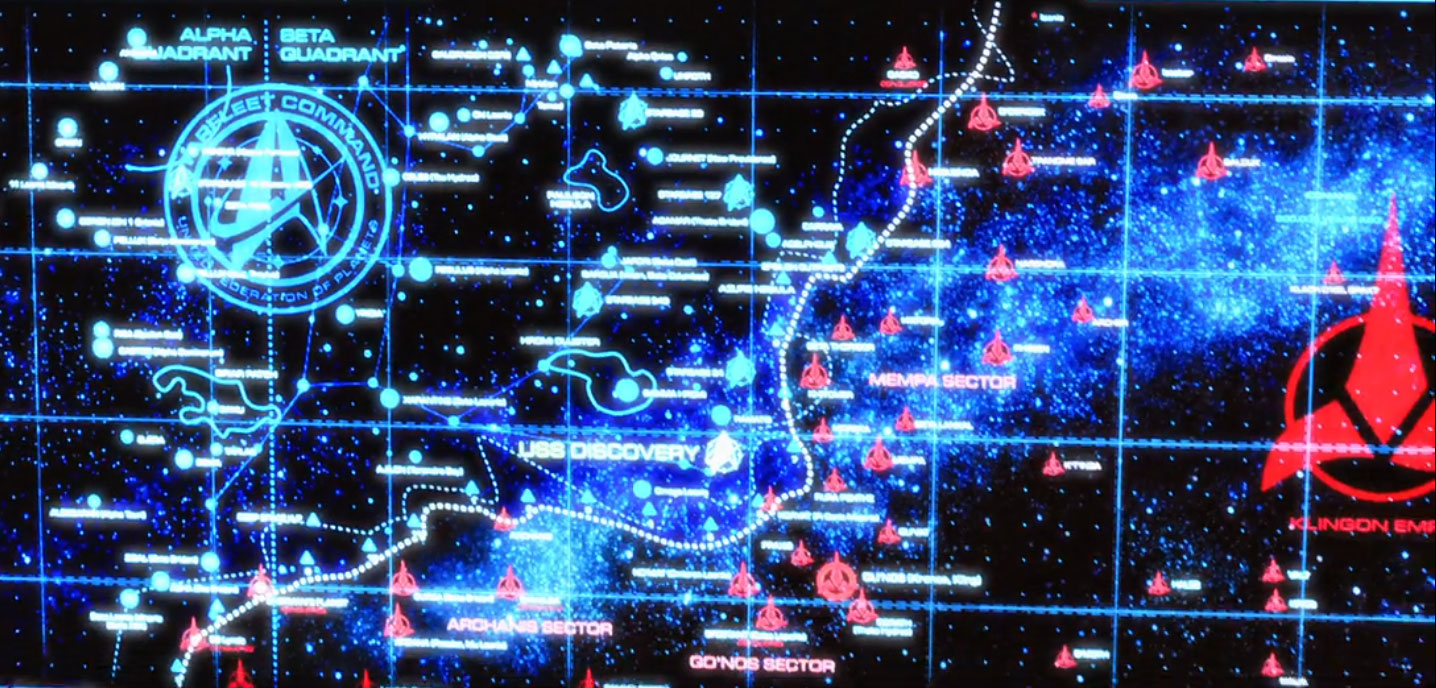

Alpha and Beta Quadrant Federation
- I've made this changes, and just wanted to add the actual map to this talk page to document stuff. -- Capricorn (talk) 20:12, February 16, 2019 (UTC)
Federation space[]
By my count there are over 90 references to "Federation space" or "Federation territory". There are plentiful maps (see above) to support such an article, so I think because something with a border around it and specific neighbors to note makes this a tangible and potentially large self supporting article of its own merit. --Alan (talk) 13:41, May 1, 2019 (UTC)
- Seems reasonable. It refers to the territory around it, not the internal matters or history.--LauraCC (talk) 16:09, May 2, 2019 (UTC)
32nd century[]
Shouldn't we update the Federation's emblem in the Sidebar? Or, as a compromise, keep the emblem but change the flag in the bottom of the Sidebar? It is the latest incarnation, after all.
Total speculation[]
There's literally zero evidence that Federation Central is a legislative body. Its only mention is the line, "Your name will figure prominently in my report to the Federation Central." To me it sounds like another name for Federation Headquarters. -- UncertainError (talk) 05:01, 15 July 2022 (UTC)
UFP funtion and future?[]
Some arguments for considering the Federation a "de facto" galactic empire include:
- Arguments for the UFP being a de facto empire
- Vast Size and Influence: The Federation spans thousands of light-years and encompasses over 150 member worlds. Its sheer size and power exert significant influence on surrounding civilizations and non-member worlds. This immense scale, according to some analyses of empires, can in itself be a defining characteristic of an empire.
- Technological and Economic Dominance: The Federation possesses advanced technology and a robust economy capable of producing a wide range of goods and services through replicator technology. This allows it to offer enticing benefits and assistance to potential member worlds, potentially making it difficult for those worlds to remain independent and resist the benefits of joining.
- Implicit Pressure to Conform: While membership is ostensibly voluntary, planets seeking to join the Federation must meet certain criteria, including achieving stable planetary political unity and prohibiting caste discrimination. This can be seen as imposing Federation values and political systems on prospective members, even if it's for their own stated benefit. Some even suggest that the Federation's strong emphasis on social responsibility and certain freedoms, while beneficial, can also be seen as a subtle form of cultural assimilation.
- Starfleet's Role: While primarily depicted as an exploration and defense force, Starfleet also plays a significant diplomatic role and often engages in "first contact" with new civilizations. Starfleet's power and advanced technology, even if used for peaceful purposes, could be perceived as a form of "gunboat diplomacy" by some, indirectly influencing these civilizations towards Federation ideals or membership.
- Vast Scale and Power: The Federation is presented as the dominant power in its region of space, with a massive territory spanning thousands of light-years and encompassing numerous star systems and species. This vast size and influence are characteristic of many empires in science fiction and history.
- Expansionist Tendencies (even if voluntary): The Federation constantly seeks new members and actively explores to encounter new civilizations, according to Reddit. While membership is presented as voluntary, the allure of Federation technology, security, and shared values can strongly influence new civilizations, according to one Quora user. This process, even without overt force, can be seen as a form of cultural and political expansionism.
- Centralized Authority and Imposed Regulations: While member planets maintain some autonomy, the Federation imposes overarching laws and regulations derived from its charter and constitution. This hierarchical structure, with a central authority governing a wide range of disparate entities, has parallels with imperial systems.
- Military Power: Despite emphasizing diplomacy and exploration, the Federation maintains a powerful space force (Starfleet) with advanced weaponry used to defend its territory and interests. While presented as defensive, this military capability makes the Federation a force to be reckoned with, potentially allowing it to exert influence even without direct conquest.
- UFP Future with the Borg
- The Borg's assimilation of the United Federation of Planets, while a significant challenge, is driven by the desire to incorporate the Federation's biological and technological distinctiveness into the collective.
Here's why the Federation presents such a worthy target:
- Technological advantages
- Adaptability and Innovation: The Federation, particularly Starfleet, constantly develops new technologies and adapts existing ones to counter threats, including the Borg themselves.
- Scientific and Medical Expertise: Advanced medical technologies and scientific research capabilities could further enhance the Borg's abilities, such as improving regeneration techniques.
- Technological Redundancy: Starfleet vessels possess redundant systems, making them highly resilient, and this could be valuable for improving Borg ships' resistance to damage.
- Advanced Holography: Federation holographic technology, like that used in advanced medical applications or for entertainment purposes, might also be repurposed for the Collective's benefit, potentially even as new weapon systems.
- Biological advantages
- Diverse Genetic Pool: The Federation encompasses a wide array of species, each with potentially unique biological traits, offering a vast pool of genetic information for the Borg to assimilate and potentially exploit.
- Adaptability to Different Environments: The Federation's diverse membership has adapted to various planetary conditions, potentially offering resistance to a wider range of environmental factors.
- Unique Physiological Traits: Individual Federation species may possess distinct physiological characteristics (e.g., enhanced strength, intelligence, sensory perception) that could be beneficial to the Borg collective.